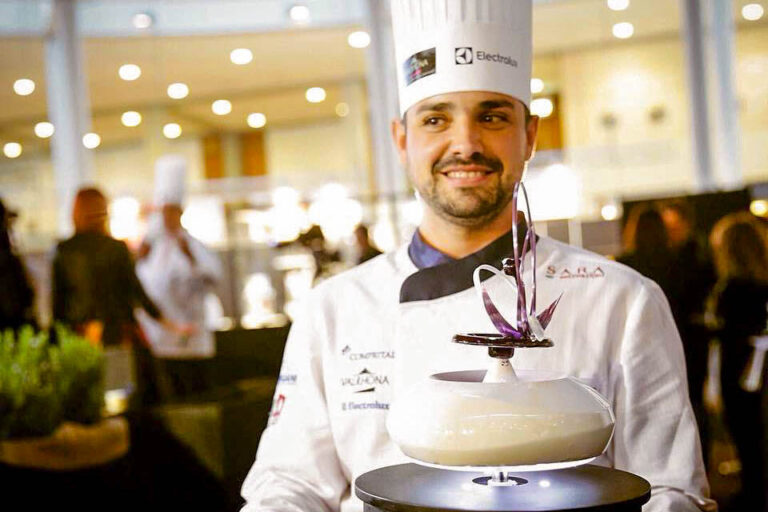


Yon Gallardo invited us to spend the morning in his workshop, a few kilometres from Irún. We came away with a full notebook: how a professional batch freezer works, why the blast freezer matters more than it seems, two final-year projects being cooked up inside, and a display case that proves you don't need to paint ice cream blue for children to eat it.
01 · The workshopA workshop that grew faster than expected
They've been in the current unit for two years. Yon tells it plainly: the business grew faster than they could absorb, so there was a lot of improvising along the way until they landed on the layout they have now. Up to 1,000 litres a day can come out of here if needed, though they aren't at that volume today: August and the holidays are another story.
02 · The machineryThe machinery, and what you can learn from it at home
The batch freezers, made by Valmar, take 12 litres of mix and turn out up to 14 litres of churned ice cream. They're water-cooled and churn in about six and a half minutes, which gives around 60 kg of ice cream per hour per machine. They have two identical ones. And a third, smaller 130 kg machine, now in its seventh year without a single breakdown.
But what's really worth looking at isn't the batch freezer, it's the blast freezer. That's the machine that freezes the ice cream at full speed the moment it comes out, and the reason is purely physical: the faster it freezes, the smaller the ice crystal that forms. Small crystal means fine texture, and above all it means that texture holds for days instead of going sandy.
At home we don't have a blast freezer, and that's a good part of the difference. The nearest thing is putting the ice cream in the coldest part of the freezer, in a low, wide container so the mass is thin, and not opening the door every five minutes.
03 · The experimentSix identical ice creams to compare six chocolates
That day they were on a very interesting batch: six ice creams in micro-lots with the exact same recipe, changing only the chocolate. They were destined for the tastings of a friend who specialises in bean to bar chocolate.
It's an exercise you can repeat at home and it teaches you an enormous amount: if you really want to know what an ingredient brings, leave the rest of the formula alone and change only that variable. Change three things at once and you learn nothing.
04 · The researchWhat's being researched inside the workshop
In the workshop there were two people out of the Basque Culinary Center working on things that, in time, will reach everyone.
A stabiliser made only from plant fibres. Nico has spent three months on his final-year project trying to replace the conventional stabiliser with a combination of fibres: citrus, flax and psyllium. They're testing percentages until they get close to the behaviour of the ice cream they already sell. We tried the experiments and the texture was pretty good.
Vegan ice creams that don't taste like a substitute. Iratxe Etxeberria has been with Yon for three years, also out of the Basque Culinary Center, and her final-year project was developing a vegan range starting from plant proteins and fats. What's interesting is the result: they went down well even with people who don't normally eat that kind of ice cream.
05 · The display caseThe display case: we tried everything
Then Yon took off his chef's jacket and took us to the shop. These are the tasting notes, in case you go:
- The classics first: vanilla, chocolate, pistachio and hazelnut. The vanilla, spectacular.
- The hazelnut is roasted considerably more than we were doing at home, and gains a great deal of flavour. Noted: roast more.
- The coffee, in two versions. The one with speciality coffee has a completely different profile from the standard.
- Cheesecake and lemon, very refined. The kind that makes you want to go home and copy it.
- The yoghurt he makes with cultures, not starting from ready-made yoghurt as we do. There's ground to explore there.
And one thing that isn't a flavour but shows all the same: it's a display case with enormous variety and not a single piece of rubbish in it. No smurfs, no flying unicorns. The children who walk into that shop eat ice cream.
06 · The way backThe thought we left with
The day before the visit we'd stopped at another ice cream shop in Hondarribia. We're naming no names. For about 3.60 € they gave us a tub considerably bigger than Yon's: plenty of ice cream, yes, but dreadful. The chocolate didn't taste of chocolate and the cream didn't taste of cream; the strawberry was reminiscent of an eighties ice lolly.
The most damning verdict wasn't ours. It came from two girls aged five and two, who said that wasn't ice cream.
So that's where the message goes, above all to anyone using bases, flavourings and colourings when they don't have to: think it over. And most especially the people who know how to do it well and still don't.
Thanks to Yon for the morning, and for almost everything we've learned over these years. If you liked this kind of video, say so and we'll make more.