
Half a litre of cream in less than a litre of mix doesn't make ice cream creamier: it makes it fatty and heavy. Fat coats the palate and flattens the flavour — a strawberry at 24% fat tastes mostly of cream — and it isn't what keeps ice cream scoopable in a home freezer either: that is decided by the PAC. Here we look at it with a real recipe and the numbers in front of us.
Hello ice cream friends. I've wanted to write this post for a long time, and with it I'm trying to stamp out the plague of internet recipes loaded with fat for no reason, whose only purpose is to fool our palate into thinking we're eating «creamy» ice cream by stuffing it with fat to the limit — and which give the ice cream an unnecessarily milky, heavy taste into the bargain.
Before building this site I went around the internet — Google, Facebook, Instagram — searching for ice cream recipes, and as a rule the first ingredient was always:
Cream 35% fat 500 g
Then add the rest of the ingredients; many recipes don't even reach 1000 g, so in less than a litre of ice cream they're putting in half a litre of cream. Easily said.
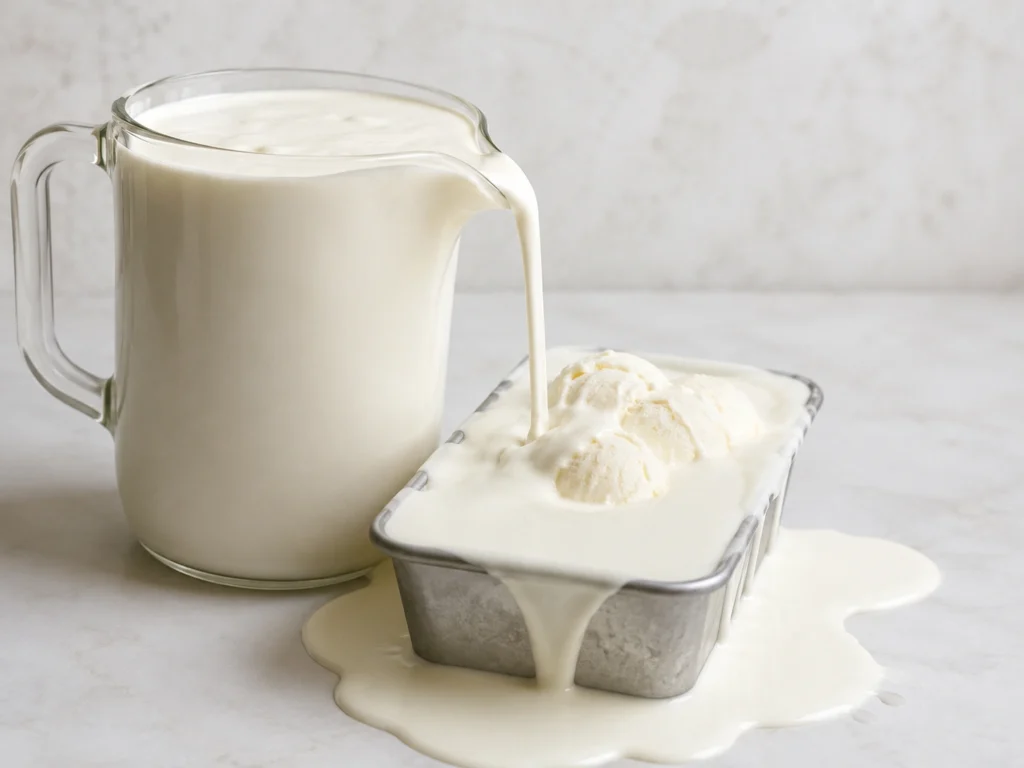
An example with the fattiest ice cream on the site
Let's look at an example. We'll take the creamiest recipe we have on the site, the cream ice cream, where we wanted to give cream more presence and go up to 12% fat, when we normally work at 8%.
CREAM ICE CREAM (HAZTUHELADO)
PRODUCT | AMOUNT |
Whole milk | 503 g |
Cream 35% fat | 293 g |
Skimmed milk powder | 40 g |
Dextrose | 66 g |
Fructose | 30 g |
Sucrose | 62 g |
Stabiliser (cream) | 6 g |
RECIPE FIGURES
Fat | 12 % |
Sweetening power (POD) | 16,3 % |
Freezing-point depression (PAC) | −11.4 °C |
Lactose | 5,42 % |
Protein | 3,7 % |
Total solids | 38 % |
Now let's search Google for any cream ice cream recipe, the first result that comes up — in this case from the site Bonviveur. This one or another, it makes no difference: they're all cut from the same cloth.
CREAM ICE CREAM (INTERNET)
PRODUCT | AMOUNT |
Cream 35% fat | 500 ml |
Egg whites | 125 g |
Invert sugar | 25 g |
Sucrose | 75 g |
RECIPE FIGURES
Fat | 24,1 % |
Sweetening power (POD) | 13,6 % |
Freezing-point depression (PAC) | −6.24 °C |
Lactose | 2,2 % |
Protein | 3,4 % |
Total solids | 43,1 % |
What happens when the fat shoots up
As you can see, the fat has shot up to 24% for no reason. I've only seen figures like that in certain «special» gastronomic ice creams, meant to go with savoury dishes where that fat made sense. You can't make every ice cream that way.
We also have to remember that plenty of other things bring fat into a recipe: chocolate, nuts, egg yolk and so on. In those flavours the fat will shoot past 30%, which is sheer madness.
And bear in mind we're comparing against the fattiest ice cream on the site; in many others we're at 4% fat. Every ice cream needs its own fat level, and in these internet recipes you end up at 25% every single time.
What all that extra fat does to your ice cream
First, in the mouth. Fat coats the palate and flattens the flavour: a strawberry ice cream at 24% fat tastes mostly of cream, and the strawberry stays behind it, muted. That's why so many internet recipes end up needing twice the fruit or cocoa for anything to come through. And it cloys: you eat two scoops and you've had enough, which is exactly the opposite of what we're after.
And then there's what you can't see. Look at the PAC of the recipe above: −6.24 °C. We aim for around −11 °C. That means this ice cream, in a home freezer at −18 °C, will set like a rock: you'll have to take it out well in advance, and by the time it's servable on the outside it's still hard in the middle. Fat gives a sense of creaminess at first, but it isn't what keeps ice cream scoopable in the freezer — the sugars do that.
What to replace all that cream with
Taking cream out isn't leaving a gap: it's filling it with what was actually needed. If you compare the two recipes above, ours does exactly that:
- Skimmed milk powder for solids and protein, which is what gives body without pushing up the fat. We aim for 3% to 4% protein.
- The right sugars for the cold. Dextrose is what lowers the freezing point and keeps the ice cream creamy at home-freezer temperature; sucrose alone doesn't get there.
- Stabiliser, in a small dose, to hold the free water so it doesn't crystallise. 6 g per kilo of mix will do you.
So how much fat does a well-made ice cream have
There's no single number, because it depends on the type. In the recipes on this site you'll move within this range:
- Fruit sorbets: 0% fat. None at all. And they come out creamy.
- Light ice creams and fruit ice creams with milk: around 4%.
- Custards: between 6% and 8%, which is where we work most of the time.
- Cream ice cream, the fattiest in the house: 12 %.
And watch out for something that always gets forgotten: some ingredients bring fat with them as standard. Chocolate, nuts, egg yolk. In those ice creams that fat has to be subtracted from the total, not added on top of the cream, or you land on absurd figures without noticing.
We've devoted this post solely to fat; in another we'll go through all the recipe figures, because they have plenty to say too.
Please look closely at the recipes you make. Ice cream is one of the most technical disciplines in the kitchen and there's a lot to take into account when formulating. In ice cream, if you make recipes up, the likeliest outcome is failure — or, as we've seen in this example, you end the summer nicely rounded, heh.
CalculateRun this same analysis on your own recipeYou put in the grams and out come fat, POD, PAC and total solids.Open the calculator →