

We run the numbers on three real recipes sent to us from the Facebook and Telegramgroups: how they were before and what changes when they're reformulated. It isn't a correction, it's a learning exercise — it helped us adjust things in our own recipes — and it's written with a domestic compressor machine.
Hello ice cream makers. At the request of the members of the Facebook group HELADOS CASEROS (ESPAÑA) and of the Telegram group, we're going to run a numerical analysis of the recipes they asked us about. These are recipes they made before finding haztuhelado, and they want to know what they've gained from these changes.
First of all, I want to tell the creators of these recipes (Felicidad, Miriam and Juan Andrés) that this is a learning exercise. In fact, doing this analysis helped me adjust some things in my own recipes that I realised were wrong. We can all learn a good deal from it. The comments I make on the recipes are made with every affection and as constructive criticism, so that we all try to move forward.
I'll do the analyses from my point of view and with the experience of the tests we've run. I'm working on the basis of churning in a domestic compressor machine (Springlane, Koenig, Cuisinart and the like). For professional machines, Pacojet and so on, it's a different matter and they'll have to be adjusted to their required parameters.
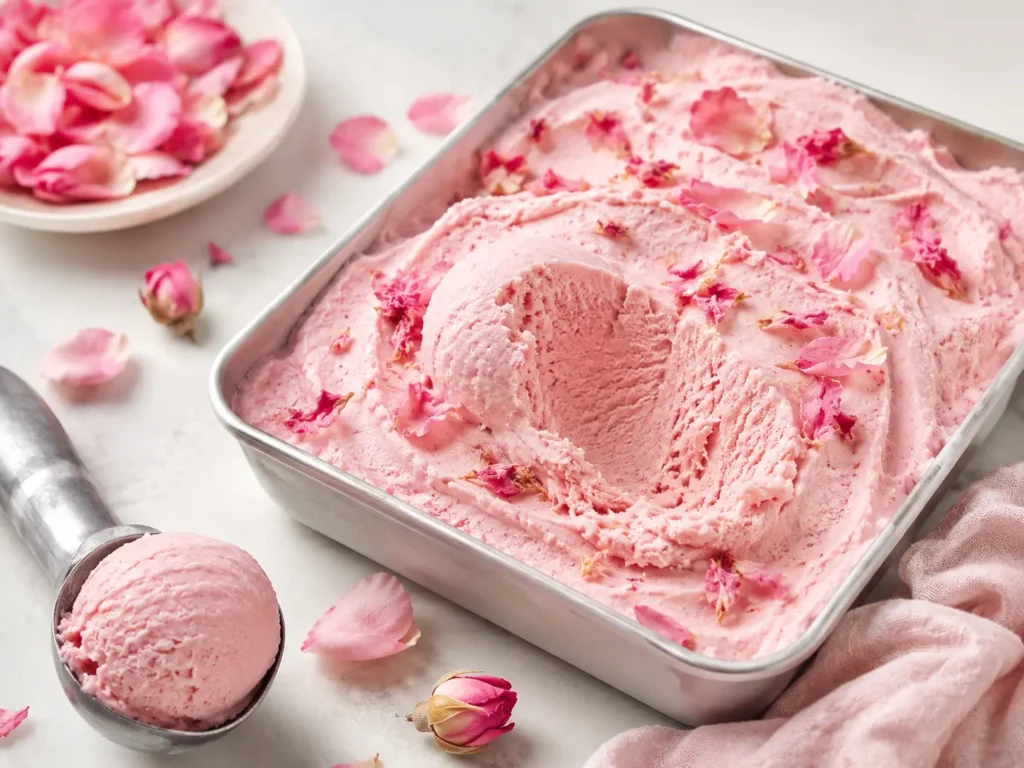
First analysis: a rose ice cream
We start by analysing the recipe of our friend Felicidad from «Knead the dough”.
ROSE ICE CREAM (Amasa la masa)
PRODUCT | AMOUNT |
Water | 400 g |
Cream 35% fat | 300 g |
Sucrose | 200 g |
Orange juice | 75 g |
Dried or fresh petals | 16 g or 200 g |
RECIPE FIGURES
Fat | 10,77 % |
Sweetening power (POD) | 21,47 % |
Freezing-point depression (PAC) | −9.42 °C |
Lactose | 0,98 % |
Protein | 0,68 % |
Total solids | 34 % |
Of the recipes I was finding online, Felicidad's were among the best directed (I don't say that just because of this recipe; I saw quite a few more). I sent her a message on Instagram and she took it very well: she joined the group quickly and put a lot of effort into improving her ice creams. She's now an important part of the ice cream community — many thanks for your always excellent contributions.
As for the recipe, the biggest problem I see is the lack of protein, which I'd put between 3% and 4% by adding skimmed milk powder (or milk protein and skimmed milk powder for the more technical).
It would also be very important to add an emulsifier and a stabiliser to the recipe. As we always do, we'd add the necessary dose of stabiliser.
And if we want to go the extra mile, we'd raise the total solids from 34% to 38% (the milk powder we're adding will help with that), and I'd set the freezing-point depression to −11 ºC by default. The POD strikes me as too high for people's current taste, so I'd bring it down to 16.5% (that's more a matter of individual taste). I usually leave the fat between 4% and 12%, depending on the ice cream.
With the changes we've discussed, I suggest you try this recipe and see whether you notice an improvement.
ROSE ICE CREAM (Haztuhelado)
PRODUCT | AMOUNT |
Water | 410 g |
Cream 35% fat | 229 g |
Skimmed milk powder | 90 g |
Dextrose | 58 g |
Glucose 38DE | 28 g |
Sucrose | 104 g |
Stabiliser (custard) | 6 g |
Orange juice | 75 g |
Dried / fresh petals | 16 g / 200 g |
RECIPE FIGURES
Fat | 8 % |
Sweetening power (POD) | 16,50 % |
Freezing-point depression (PAC) | −11.26 °C |
Lactose | 5,39 % |
Protein | 3,70 % |
Total solids | 38 % |
Second analysis: a turrón ice cream
Another suggestion from our readers is two recipes from the site «El invitado de invierno», a very well-known site that has been running a long time with excellent content. This time I haven't spoken with Miriam personally, but you can see someone who tries to improve her recipes day by day. In fact, I've seen her ice cream recipes evolve.
TURRÓN ICE CREAM (El invitado de invierno)
PRODUCT | AMOUNT |
Evaporated milk | 290 g |
Cream 35% fat | 240 g |
Sucrose | 90 g |
Egg yolks | 60 g |
Turrón (70% almond) | 300 g |
RECIPE FIGURES
Fat | 21,71 % |
Sweetening power (POD) | 19,46 % |
Freezing-point depression (PAC) | −6.15 °C |
Lactose | 2,41 % |
Protein | 2,61 % |
Total solids | 55 % |
In this recipe, the first thing that jumps out is the fat and total solids percentages.
As we said in the other analysis, we usually leave the fat at 8%, and here it has shot up to 21.71%. The problem is putting in so much cream. We have to bear in mind that turrón, if we're working with 70% almond, already brings plenty of fat, and that has to be counted. Besides, if we use egg yolk, that brings fat too.
Another important problem is the total solids. We normally work in a range between 38% and 40%, reaching 42% in some cases, but 55% is a great deal. The problem is putting in so very much turrón. It's great that it tastes of turrón, but you have to put in the maximum the recipe allows.
On the other hand, the recipe falls a long way short on anti-freezing sugars. I'd take it to −11 ºC, and that could be solved with dextrose. It's also short on protein, and we'd solve that with skimmed milk powder. The POD, for people's current taste, is high.
Honestly, I've never seen evaporated milk used in ice cream; water and skimmed milk powder would be enough.
As for emulsifier, the recipe has egg yolk, and with that much fat the ice cream would be more than stabilised. If we bring the fat down to sensible values, we'd add stabiliser (in a smaller amount, since it already has yolk).
Since we already have two turrón ice cream recipes on the site (one with a bar of turrón and one with Marcona almond), here they are.
Third analysis: a vanilla ice cream
On to another of Miriam's recipes that readers asked about, this time a vanilla ice cream.
VANILLA ICE CREAM (El invitado de invierno)
PRODUCT | AMOUNT |
Whole milk | 320 g |
Cream 35% fat | 400 g |
Sucrose | 130 g |
Egg yolks | 80 g |
Salt | 1 g |
Vanilla pod | 1 u |
RECIPE FIGURES
Fat | 18,99 % |
Sweetening power (POD) | 14,42 % |
Freezing-point depression (PAC) | −6.68 °C |
Lactose | 3,02 % |
Protein | 3,45 % |
Total solids | 40,26 % |
With this recipe, what we see straight away is the fat again. It's very high once more. On the other hand, the total solids are in decent shape.
On PAC it's similar to the previous one. The anti-freezing sugars need reinforcing to reach −11 ºC and, curiously, the POD is quite low. I'd raise the sweetness a little.
On protein, the recipe is fine.
To me, this ice cream, having egg in it, feels more like a mantecado than a vanilla ice cream. I suppose that, depending on the region, it's called one thing or the other. If you wanted a pure vanilla ice cream you'd have to take out the egg, and then we'd have to add the usual dose of stabiliser.
Here are the vanilla and mantecado recipes from the site.
Fourth analysis: a truffle ice cream
Our friends in the group also suggested this ice cream from the site «El dulce objetivo», a site with spectacular recipes and photos. I have spoken to Juan Andrés on occasion because I love commenting on his ice cream recipes (he must be sick of me), and he's promised he'll make an ice cream from our site (heh). We want one of those lovely photos you take when you do.
TRUFFLE ICE CREAM (El dulce objetivo)
PRODUCT | AMOUNT |
Cream 35% fat | 700 g |
Invert sugar | 60 g |
70% couverture | 80 g |
Amaretto | 30 g |
RECIPE FIGURES
Fat | 34 % |
Sweetening power (POD) | 14,21 % |
Freezing-point depression (PAC) | −6.42 °C |
Lactose | 2,06 % |
Protein | 1,41 % |
Total solids | 58,53 % |
As for the recipe, I think Juan Andrés wanted to take the classic pâtisserie truffle and apply it to ice cream. This recipe could be made without churning, making the classic truffle you coat, freeze and eat.
I'm going to treat it under the parameters of what an ice cream should be, and so it gives impossible values for fat and total solids. The problem, clearly, is the 700 g of cream. It's been a while since I saw that much cream in an ice cream (I already complain at 500 g, heh). Bear in mind that 70% couverture already brings plenty of fat, and if on top of that you add that much cream, it gets out of hand.
As we said, those total solids have to come down, at least to the 38-42% range, so that the ice cream isn't so heavy.
The recipe, carrying so much fat, is more than stabilised, since there's practically no free water left to capture.
This ice cream needs more protein, taken into the 3-4% range with skimmed milk powder, and more anti-freezing sugars to bring it to −11 ºC PAC. For that we can play with dextrose, fructose and sucrose. I'm not much in favour of using invert sugar because of the extreme sweetness it brings, although in this case the POD has ended up a little short.
Since I have two chocolate ice cream recipes, here they are. We're working on another, lighter on chocolate and with more of a cream flavour (but balanced), perhaps closer to what's known as truffle, which we'll put up shortly.
CONCLUSIONS
As we can see, the general tone in internet recipes is a brutal excess of fat and solids.
New trends, easier access to information and products, and a growing awareness of what we eat all mean we want to look for added value in ice cream.
Traditionally the ice cream people ate was one in which the fat percentage was no concern beyond the purely sensory. A fatty ice cream, usually with values above 8% fat, meant a «creamy» ice cream.
That's a little deceptive, because although the ice cream feels creamy in the mouth, it turns cloying and heavy from the excessive amount of fat.
We have to try to lower the fat percentage, because it can be very positive in many respects.
It's also necessary to understand sugars properly: you can't reach for invert sugar by default, because it's extremely sweet. Dextrose has the same freezing-point depression and is much less sweet, which gives you far more room to work.
CalculateRun this same analysis on your own recipeYou put in the grams and out come fat, POD, PAC and total solids.Open the calculator →That's today's analysis; let us know in the comments whether you found it useful and interesting and we'll try to do more of this kind of thing.